

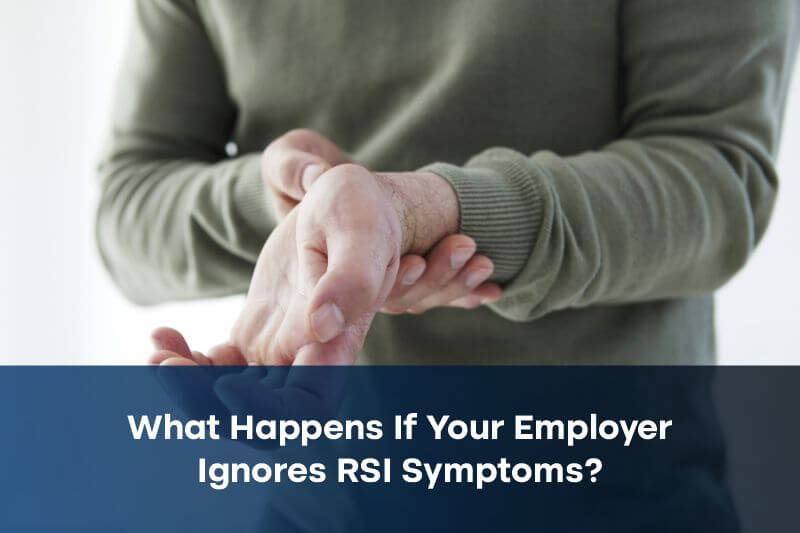
What Happens If Your Employer Ignores RSI Symptoms?
admin2026-04-04T07:53:57+00:00You report aching wrists, stiff shoulders or constant tingling in your fingers after long hours at work. Your manager nods, promises to look into it, [...]
You report aching wrists, stiff shoulders or constant tingling in your fingers after long hours at work. Your manager nods, promises to look into it, [...]
You report aching wrists, stiff shoulders or constant tingling in your fingers after long hours at work. Your manager nods, promises to look into it, and then nothing changes. The pain grows worse, your productivity drops, and you start worrying about your job and your future.
This scenario plays out far too often. When your employer ignores RSI symptoms, the consequences stretch far beyond discomfort. You face real risks to your health, your income and your career. At Jiva Solicitors, we see these cases every week. This article explains exactly what happens next, what your employer must do by law, and the clear steps you can take to protect yourself and secure the compensation you deserve.
Repetitive strain injury covers a group of conditions caused by repeated movements, awkward postures or prolonged use of the same muscles. Common examples include carpal tunnel syndrome, tennis elbow, tendonitis and neck or shoulder strain. Office workers who type all day, factory staff on assembly lines, and delivery drivers who lift packages repeatedly all sit at a higher risk.
The early warning signs feel mild at first: soreness, stiffness, numbness or a burning sensation. Most people push through because the pain comes and goes. But without changes to the way you work, the damage builds. Tissues inflame, nerves compress, and muscles weaken. What starts as an annoyance can quickly become a long-term problem that stops you from doing your job properly.
Employers often downplay these symptoms because they assume everyone gets a bit sore after a busy shift. Yet the law treats RSI as a serious workplace hazard, not an inevitable part of the job.
You hold clear rights the moment you tell your employer about your symptoms. Under the Health and Safety at Work etc. Under the Act 1974, your employer must take reasonable steps to keep you safe. That duty includes assessing risks from repetitive tasks and acting on the information you provide.
You also benefit from the Management of Health and Safety at Work Regulations and, for desk-based roles, the Health and Safety (Display Screen Equipment) Regulations. These rules require employers to:
If you have already developed a condition that counts as a disability under the Equality Act 2010, your employer must make reasonable adjustments. Ignoring your report breaches these duties and leaves them open to a claim.
Some employers dismiss reports outright. Others promise action but never follow through. You might recognise these patterns:
These responses do not meet legal standards. They shift responsibility onto you and allow the injury to worsen. At Jiva Solicitors, we gather evidence of exactly this kind of inaction every time we handle a repetitive strain injury claim.
When your employer ignores RSI symptoms, the physical effects escalate fast. Pain that once appeared only at the end of the day now lasts all night. You lose grip strength, drop tools or struggle to type. Simple tasks like holding a phone or driving become difficult.
Many clients tell us they cannot sleep properly, which leads to exhaustion and low mood. Some develop anxiety about losing their job or facing financial pressure. In severe cases the injury becomes permanent. People have to change careers, accept lower-paid roles or leave work altogether.
The financial impact hits hard, too. You may need time off for medical appointments or physiotherapy. Lost wages add up, especially if statutory sick pay runs out. Medical costs, travel to specialists, and even adaptations to your home can create extra strain.
UK law places the main responsibility on the employer, not the employee. They must prevent harm where they can reasonably do so. That means acting on your report rather than waiting until the injury forces you off work.
A proper response includes:
Failure to follow these steps amounts to negligence. You can use that negligence to support a personal injury claim for compensation. Courts look at whether the employer knew (or should have known) about the risk and whether they responded adequately.
You do not have to wait for your employer to act. Start protecting your position today with these practical steps:
Early action strengthens your case and often encourages your employer to settle quickly once they see you mean business.
At Jiva Solicitors, we focus on helping people whose employers ignored clear RSI symptoms. Our team knows the law inside out and understands how these injuries affect daily life. We handle the entire process for you so you can concentrate on recovery.
We work on a no-win, no-fee basis in most cases. That removes financial risk and lets you pursue the compensation you need for pain, lost earnings, medical expenses and any long-term effects. Many clients also recover funds for adaptations to their home or car.
If your employer ignored your RSI symptoms and your condition has worsened as a result, you may have a strong claim. The experienced repetitive strain injury claim solicitors at Jiva Solicitors will review your situation for free and explain your options simply. We have helped hundreds of clients secure settlements that cover their losses and give them peace of mind.
Your health matters more than any deadline or production target. When your employer ignores RSI symptoms, you face unnecessary pain and uncertainty. You do not have to handle this alone.
Contact Jiva Solicitors now for straightforward advice tailored to your case. Call us, send a quick message through our website or visit us.
We will listen, explain your rights and guide you through every step. The sooner you act, the stronger your position becomes and the faster you can start feeling better. Reach out today – we are ready to help you get the support and compensation you deserve.